

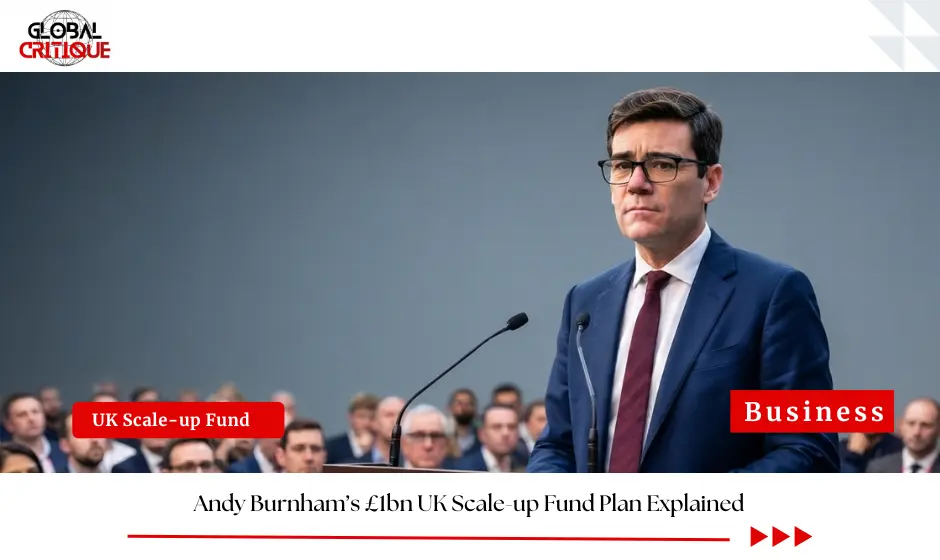

UK Scale-up Fund Explained: What the £1bn Proposal Would Do
The UK Scale-up Fund is a proposed investment vehicle of more than £1 billion that would pool money from major British pension providers to finance high-growth UK science and technology companies. The plan was announced on July 27, 2026. They’re just figuring it out now but do have the government’s backing, however, no actual fund is operating and no company has been identified.
What Happened
A group of large pension providers agreed to explore creating the fund with support from the British Business Bank and the Office for Investment. The schemes represented in the Official Announcement are Railpen, Nest, Local Pensions Partnership Investments, LGPS Central and Border to Coast.
The proposal intends to match long-term pension capital to incumbent UK companies needing bigger fundraising rounds to commercialise products, increase production, or go international.
The British Business Bank intends to invest alongside the group. However, neither the Bank’s proposed contribution nor the amount expected from each pension provider has been disclosed.
Key Details of Andy Burnham’s UK Scale-up Fund Plan
The Fund Would Target Scale-ups Rather Than Ordinary Startups
Despite searches for a UK pension fund for startups, the proposal is mainly designed for scale-ups. These are companies that have moved beyond the earliest startup phase and are attempting to expand quickly.
The government says the UK Scale-up Fund would focus on opportunities created through British science and technology. It has not published formal eligibility rules, minimum investment sizes or a complete list of sectors that could qualify.
Likely areas may include industries already supported by the British Business Bank, such as life sciences, deep technology, artificial intelligence, advanced manufacturing, clean energy and financial technology. That sector list reflects the Bank’s existing portfolio rather than confirmed rules for the new fund.
Pension Money Would Be Invested Commercially
The proposal is not a government grant programme. Pension providers would invest with the aim of generating competitive long-term returns for their members.
Trustees and investment teams would still have to consider risk, value, diversification and their legal duties to pension savers. The Mansion House Accord also states that pension investment ambitions remain subject to fiduciary and consumer duties.
The announcement does not mean that individual savers can apply to the fund or choose which companies receive money. It also provides no guarantee of higher pension returns.
Private businesses can grow significantly, but these investments may take years to mature and can be harder to sell than shares traded on public markets.
The Fund’s Structure Is Still Undecided
The government described the UK Scale-up Fund as a vehicle that pension providers are exploring rather than a completed fund.
A launch date, investment period, management fee, target return, regional allocation and final mandate have not been announced. A market engagement process to appoint an investment manager is expected to begin shortly.
Timeline of Events
In May 2025, 17 major workplace pension providers signed the voluntary Mansion House Accord. They expressed an ambition to invest at least 10 percent of their main default funds in private markets by 2030, with at least 5 percent of total assets directed towards UK private markets.
- On 1 April 2026, British Growth Partnership Fund I reached a first close of £200 million. Its investors included Aegon UK, Cushon Master Trust, M&G and the British Business Bank.
- On 29 June 2026, the British Business Bank reported that its direct equity investment across more than 50 UK scale-ups had exceeded £600 million.
The new £1bn UK Scale-up Fund proposal was announced on 27 July 2026. Its next formal step will involve engaging with the investment market and exploring the appointment of a fund manager.
Why This News Matters
It creates well-backed university spinouts, tech startups and research companies, but far too many can’t raise late-stage funding to stay the course and continue to expand in Britain.
The June 2026 parliamentary report highlighted that the country currently performed very well at the creation stage of companies while struggling at the scale up phase of companies. The same study noted that UK pension schemes manages hundreds of billions pounds of long term savings.
That difference may encourage founders to seek financing overseas, sell their company earlier than anticipated, or locate key parts of their operations close to foreign investors.
A larger domestic growth fund could help companies finance expensive laboratory research, manufacturing facilities, regulatory approvals, recruitment and international expansion without relying entirely on overseas capital.
The proposal is also a test of whether pension reform can turn long-term savings into productive British investment while protecting the financial interests of pension members.
Who Could Be Affected?
High-growth companies may gain another source of large and patient investment. Venture capital managers could receive a stronger route to institutional backing, while pension providers may gain access to British private companies that are difficult to invest in individually.
Workers and regional economies could benefit when funded businesses create skilled jobs, expand production and keep intellectual property in the UK.
Pension members would be affected indirectly through investment performance. They would not receive a separate account or guaranteed payment from the UK Scale-up Fund.
Official Response and Industry Reaction
Mr Burnham announced the proposal while unveiling plans to better link pension investment with British businesses, emerging technologies and local growth.
Chancellor John Healey said Britain was good at creating companies and now needed more homegrown investment to assist successful ventures reach higher.
Railpen, Nest, LPPI, LGPS Central and Border to Coast executives commented on the fund potentially providing long-term investments with innovation and jobs. Their responses also stressed investment discipline and their responsibility to pension members.
Concerns remain about encouraging pension providers to favour domestic investments for political reasons. Critics argue that trustees must continue selecting assets based on expected risk and returns rather than government priorities alone. Discussions about the fund’s mandate and structure remain at an early stage.
Important Background and Context
The UK Scale-up Fund would sit alongside existing British Business Bank programmes rather than replacing them.
British Growth Partnership Fund I had a £200 million first close, while the Bank has expanded its own direct investment into high-growth companies. The proposed fund would be more than five times the size of the British Growth Partnership’s initial close if it reaches the stated £1 billion ambition.
It would also combine different forms of pension capital. The participating providers represent defined contribution schemes, defined benefit schemes and Local Government Pension Scheme funds.
The proposal supports Burnham’s broader focus on spreading investment and economic decision-making beyond London. That agenda also appears in the government’s use of No 10 North in Manchester.
Possible Next Steps
The consortium must appoint an investment manager, agree investment rules and secure binding financial commitments.
It will also need to explain how companies will be selected, whether funding will be distributed across UK regions and how financial performance will be reported.
Other important questions include management fees, investment timeframes, minimum deal sizes, governance arrangements and how conflicts between economic policy and pension duties will be handled.
Until those decisions are published, the UK Scale-up Fund should be treated as a serious proposal rather than a completed investment programme.
What Readers Should Know
No application process has opened for businesses, and no first investments have been announced.
Pension savers do not need to take action or change their existing arrangements because of the proposal. Readers can learn more about wider retirement policy changes in Global Critique’s guide to UK pension reform in 2026.
The most useful details to watch will be the confirmed fund size, final investors, management fees, risk controls, first investments and expected launch date.
Conclusion
Andy Burnham’s UK Scale-up Fund plan could direct more than £1 billion of pension-backed capital into British science and technology scale-ups.
The announcement is significant, but the fund remains at the design stage. Its success will depend on whether it produces competitive returns while helping strong UK companies grow and remain in Britain.
Read beyond the business headlines and follow the decisions shaping Britain’s economy with Global Critique.
Frequently Asked Questions
What Is the UK Scale-up Fund?
The UK Scale-up Fund is a proposal to channel finance into high-growth British science and technology companies, with investors providing bulk financing via major pension providers.
How Much Money Would the Fund Invest?
The consortium is exploring a fund worth more than £1 billion. The final amount has not been confirmed.
Has the UK Scale-up Fund Already Launched?
No. It was announced on July 27, 2026 and the launch structure, manager and launch date have not yet been finalised.
Which Pension Providers Are Involved?
The official announcement included Railpen, Nest, LPPI, LGPS Central and Border to Coast.
Is the Fund Controlled by Andy Burnham’s Government?
The government supports the proposal, but the participating pension providers are exploring the fund as an investment vehicle. The British Business Bank intends to invest alongside them.
Will the Fund Invest in New Startups?
Its main focus would be scale-ups rather than very early-stage startups. Formal eligibility requirements have not yet been published.
Which Industries Could Receive Investment?
The government has identified science and technology as the main focus. A full list of eligible industries has not been confirmed.
Will Pension Savers Be Forced to Invest?
Individual savers would not select companies directly. Pension trustees and investment managers would make decisions under existing legal and fiduciary duties.
Does the Fund Guarantee Better Pension Returns?
No. The proposal’s objectives are to achieve long term gains, but all investments are risky, and the return has not been secured.
When Will the First Investments Be Announced?
No timetable has been published. The consortium must first finalize the fund structure and explore the appointment of an investment manager.