

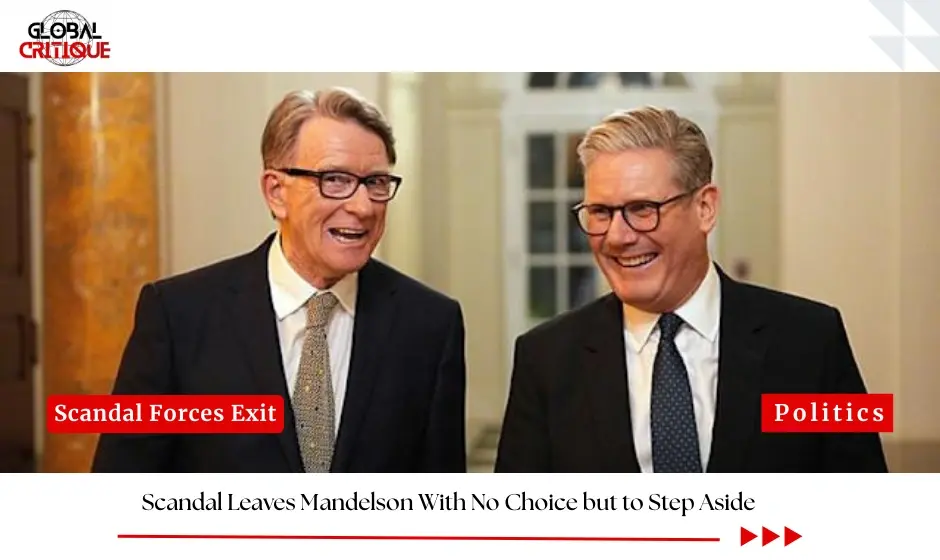

Peter Mandelson Faces Political Collapse After Epstein Revelations
The scandal leaves Mandelson as a defining test of judgement, accountability and public trust in UK politics. Peter Mandelson resigned from Labour on 1 February 2026 after new details in material released by the US Department of Justice renewed scrutiny on his relationship with Jeffrey Epstein. Mandelson said he had no record or recollection of alleged payments and did not want to further embarrass the party. His subsequent departure from the House of Lords made the political cost unmistakable. The published material and police action must be reported carefully as allegations and investigations, not proof of criminal guilt.
Why Mandelson Stepped Aside
Mandelson’s decision was not a routine party-management move. He had been one of Labour’s most recognised political operators, and he served as the UK ambassador to the United States from February 10, 2025, until September 11, 2025. The new disclosures revived questions that were already politically damaging because they concerned his past relationship with Epstein.
The immediate issue was the seriousness of the material, not simply the arrival of more documents. Reporting on the records said they appeared to show payments to accounts connected to Mandelson or his husband and correspondence relating to policy. “I have no record; I have no recollection of the alleged payments,” said Mandelson. I’ll investigate. The distinction is crucial because publishing a document or allegation does not create legal liability.
A Decision Framed as Protecting Labour
Mandelson’s own language made clear why he withdrew from Labour. He said he did not wish to create further embarrassment for the party. In political terms, that statement acknowledged the core problem. Remaining in place would have kept attention on his personal conduct rather than the unanswered questions now facing government institutions.
Parliament’s official record shows that Mandelson’s Labour affiliation ended on 1 February 2026. He is shown as non-affiliated for a short time before retiring from the Lords. And that timeline is important because it shows how quickly the controversy moved from a party issue to a larger issue of public office and standards.
What Made the Scandal More Serious
The controversy moved beyond reputational damage when ministers said an initial review of the Department of Justice material had identified information that was likely to be market-sensitive and related to the 2008 financial crisis and the government response that followed. The government referred the matter to the Metropolitan Police.
That raised two separate questions. First, what exactly did the released material show about communications between Mandelson and Epstein? Second, did existing safeguards adequately protect sensitive government information and assess risks around senior public appointments?
Allegations Need Careful Reporting
A credible account must separate known institutional actions from contested claims. It is established that Mandelson left Labour, that Parliament lists him as retired from the House of Lords, and that the government referred material to the Metropolitan Police. It is also established that ministers began reviewing vetting, disclosure and Lords disciplinary procedures.
It would be irresponsible to turn every item in released files into a proven fact. News coverage should attribute allegations, identify the document or source behind them, include Mandelson’s response where available, and avoid implying a criminal finding before one is made. This approach protects readers from speculation and keeps attention on what public bodies must now explain.
Why the Issue Reaches Beyond One Politician
The Mandelson case has sparked a wider investigation into British political appointments, government information, and elite accountability. The government announced on 9 February 2026 that it would seek changes to allow peerages to be removed from House of Lords disgracemakers. It also asked that politically appointed diplomatic candidates who need access to highly classified information undergo national-security vetting before being appointed.
Those proposals acknowledge that a resignation does not close every institutional question. They also address a concern that has followed the story since the beginning: whether existing checks were robust, transparent enough and sufficiently independently enforced.
The later parliamentary process underlined the scale of the review. On June 1, 2026, the government said it had laid down a second tranche of documents dealing with Mandelson’s appointment, vetting, and communications with ministers, advisers, and officials. Some materials remained subject to safeguards involving national security, international relations, and police considerations.
Starmer Faces Political Pressure
For Keir Starmer, the damage extends beyond Mandelson’s personal decisions. to Mandelson’s personal decisions. The appointment of Mandelson as ambassador, the handling of warnings and the quality of the vetting process have become questions of prime-ministerial judgement. When a government presents itself as committed to higher standards, the gap between that promise and its procedures becomes especially consequential.
The resignation of a senior Downing Street aide and continued parliamentary scrutiny ensured that the story also became a test of the wider system around the prime minister.
Global Critique’s report on the Mandelson crisis inside government explains how the fallout reached the centre of government. The wider leadership consequences: As Starmer’s resignation pressure intensifies, we explore the wider leadership consequences. as Starmer’s resignation pressure intensifies.
What Readers Should Watch Next
The next phase depends on official disclosures, police updates and Parliament’s response to planned reforms. Readers should watch whether the government publishes additional relevant documents, how it implements vetting changes, whether Parliament advances peerage-removal legislation and whether formal investigations produce further findings.
The broader Epstein story also remains central. Global Critique’s coverage of the Epstein files and Andrew’s link offers further context on why the UK debate extends beyond one individual.
Global Critique Analysis
In that sense Scandal Leaves Mandelson is a story of the limits of political damage limitation in the end. Stepping aside might ease the immediate pressure on a party but it does not answer questions about decisions over appointments, the handling of documents or the safeguards designed to protect the public interest.
The lasting test for the government is whether it replaces reactive statements with clear and verifiable reforms. For readers, the most reliable approach is to use primary documents, official statements and carefully attributed reports. This is how one can maintain the distinction between evidence, allegations, and political opinions. This approach allows for the maintenance of the distinction between evidence, allegation, and political opinion, even as the facts continue to evolve. while the facts continue to develop.
Follow Global Critique for verified UK political reporting that explains what happened, why it matters and what’s next.
FAQs
Why did Peter Mandelson leave Labour?
Peter Mandelson left Labour on 1 February 2026 after renewed scrutiny linked to Epstein-related disclosures. “I’d rather not cause the party more embarrassment,” he said.
Has Peter Mandelson left the House of Lords?
Yes. Peter Mandelson has the UK Parliament has classified Peter Mandelson as retired from the House of Lords. as retired from the House of Lords by the UK parliament.
What did the UK government say about the Mandelson case?
The government said its review of released material led to a referral to the Metropolitan Police. It also announced plans to change peer removal rules, senior appointment processes, peer removal rules, senior appointment processes and security vetting.
What documents were released in June 2026?
June 1, 2026, saw a second government document release. Examples include Mandelson’s appointment, vetting, and relationships with ministers, advisers, and officials.
Why is the Mandelson scandal important for UK politics?
The story raises bigger questions about public standards, diplomatic appointments, the management of sensitive information and accountability in government. It also creates political pressure on the Labour government because Mandelson’s appointment and vetting are under scrutiny.