

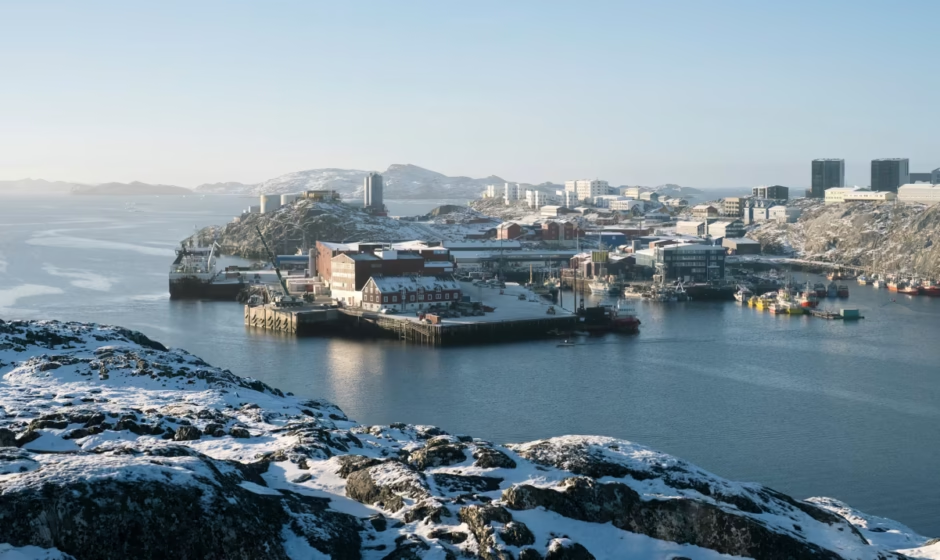

The renewed interest by former U.S. President Donald Trump in acquiring Greenland has sparked intense global debate, raising questions about national security, geopolitical rivalry, natural resources, and influence in the rapidly changing Arctic region. Far from being a passing idea, this pursuit reflects a complex blend of strategic, economic, and political ambitions.
At the core of the interest in Greenland is its unique strategic location. The island sits between North America and Europe above the Arctic Circle, a region of growing importance as climate change opens new sea routes and military vantage points. Control of Greenland would offer the United States direct influence over key pathways for maritime and aerial navigation, enhancing early warning systems and defense capabilities against potential adversaries.
Natural resources are also central to the discussion. Greenland is rich in rare earth minerals and other critical materials essential for modern technology, energy infrastructure, and defense systems. As nations compete for secure access to these resources, Greenland’s deposits have attracted attention as part of broader efforts to diversify supply chains and reduce dependence on rival powers. The Arctic itself is increasingly viewed not merely as a frozen frontier, but as a potential hub for future economic opportunity.
This geopolitical value is intertwined with broader global competition, especially between the United States, Russia, and China. Each of these powers has been expanding its footprint in the Arctic through military presence, research, and infrastructure investment. For U.S. policymakers advocating a presence in Greenland, the argument goes beyond territorial claims; it involves maintaining influence in a region where strategic balance is shifting.
However, the pursuit of Greenland raises profound diplomatic and legal challenges. Greenland is a self-governing territory within the Kingdom of Denmark, and both Danish and Greenlandic leaders have firmly resisted calls for sale, annexation, or external control. This stance has drawn clear lines around sovereignty and the right of local populations to determine their own future. Additionally, major NATO allies have voiced concern about any actions that might undermine alliance unity or international norms.
Public opinion both within the U.S. and in Greenland itself strongly favors self-determination, further complicating any attempt to alter the island’s status. Even if discussions around purchase or association continue, the pathway toward change would require careful negotiation, respect for autonomy, and an alignment of interests among multiple governments.
In conclusion, Trump’s renewed focus on Greenland is driven by a mix of security concerns, resource competition, and geopolitical strategy, but it runs up against strong opposition rooted in sovereignty and international law. Whether this pursuit evolves into formal negotiations, long-term partnerships, or simply remains a political talking point, it underscores how much the Arctic has become central to 21st-century global power dynamics