

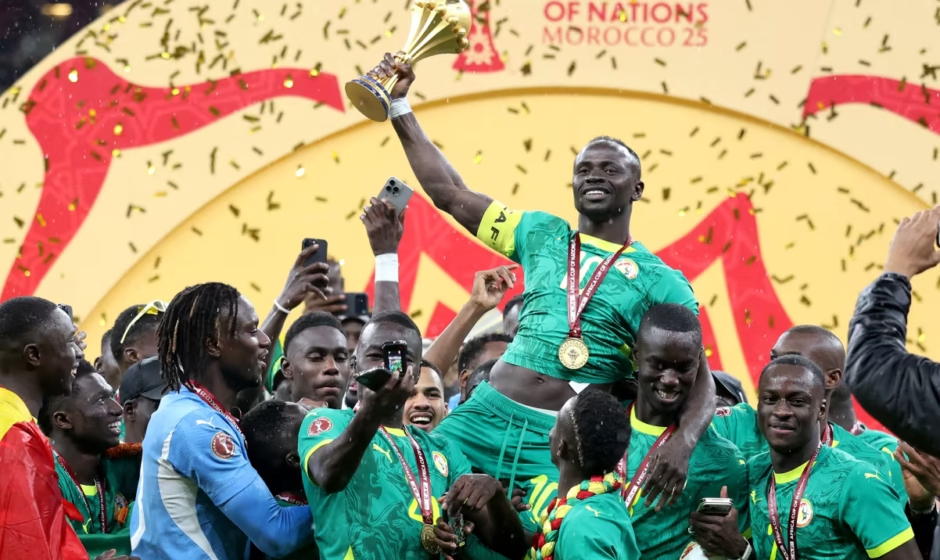

Football finals are supposed to be moments of clarity ninety minutes where preparation, talent, and discipline decide everything. But sometimes, the weight of expectation becomes too heavy, and the game itself slips out of control. That’s what unfolded in what is now being remembered as one of the most chaotic finals in African football history.
From the opening moments, tension was visible. Players weren’t just competing against each other; they were battling pressure, noise, and the fear of failure. In high-stakes matches, human behavior often shifts before tactics do. Decisions become rushed. Reactions become emotional. Every whistle feels personal.
As the match progressed, frustration began to surface. Protests from players weren’t simply about officiating they were expressions of disbelief and helplessness. When athletes feel the outcome slipping beyond their control, the instinct to challenge authority intensifies. It’s a deeply human response: when effort no longer guarantees fairness, anger fills the gap.
The penalty incident became the emotional breaking point. Penalties already carry enormous psychological weight, compressing an entire tournament into a single moment. When controversy surrounds that moment, it magnifies everything fear, rage, disbelief. Players freeze, fans erupt, and the atmosphere turns volatile.
Crowd reaction played its own role. Supporters are not passive observers; they feed emotion back into the game. When fans sense injustice, outrage spreads rapidly. Booing turns into fury. Celebration turns into confrontation. Collective emotion, once unleashed, is difficult to contain.
What followed was less about football and more about behavior under stress. Officials struggled to regain control. Players oscillated between discipline and defiance. The match drifted from competition to confrontation, showing how fragile order can be when trust breaks down.
From a psychological perspective, this final wasn’t an anomaly it was a collision of expectations. Players carried national pride. Fans carried decades of hope. Officials carried authority. When all three cracked at once, chaos filled the space.
Importantly, moments like this force uncomfortable reflection. Football thrives on passion, but passion without structure becomes destructive. The line between intensity and instability is thinner than many realize.
This final will be remembered not just for who lifted the trophy, but for what happens when pressure overwhelms systems meant to manage it. It exposed vulnerabilities in officiating, in crowd control, and in emotional regulation at the highest level.
In the end, the chaos wasn’t caused by a single decision or incident. It was the result of accumulated tension finally boiling over. And it serves as a reminder that even the biggest stages are still shaped by very human limits.
Football may be a game, but moments like this reveal something deeper: when emotions outrun structure, the spectacle becomes unpredictable and history gets written in disorder rather than celebration.