

High Court Rules UK Government’s Ban on Palestine Action Unlawful
In a major legal decision, the High Court of England and Wales ruled that the UK government’s move to ban the activist group Palestine Action was unlawful. Campaigners and civil rights advocates have welcomed the judgment, while the government confirmed it plans to challenge the ruling through an appeal.
Background to the Government Ban
The UK government, led by Prime Minister Keir Starmer, had designated Palestine Action as a terrorist organization last year. Officials argued that the group posed a national security threat after a series of high-profile protests and acts of property damage linked to defence and military sites.
The decision placed the group alongside internationally banned armed organisations under the Terrorism Act 2000, making membership or public support a criminal offence carrying heavy penalties.
What the Court Ruling Means
Judges at London’s Royal Courts of Justice concluded that the government’s decision was disproportionate. Legal experts say the verdict strengthens arguments around protest rights and freedom of expression.
Barristers explained that the ruling could affect how ongoing cases and previous arrests are handled. Police have already signalled they will stop arresting individuals for holding placards or showing symbolic support connected to the campaign, although legal uncertainty remains while the appeal process is considered.
Impact on Arrests and Prosecutions
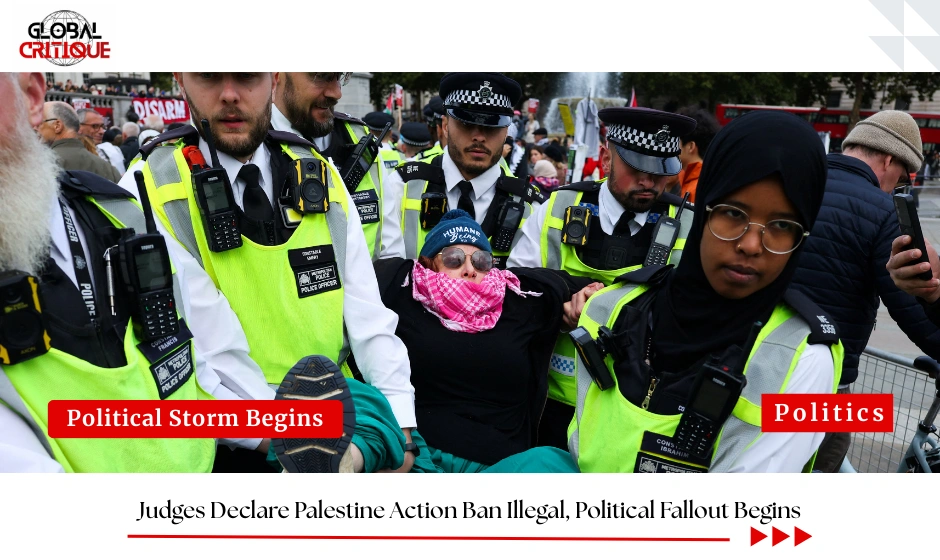
Thousands of people were detained during the ban period for actions such as silent vigils and public demonstrations. Campaign groups claim that many arrests related to peaceful protest could now be reconsidered.
However, activists accused of offences such as criminal damage or trespassing may still face prosecution, as those charges are separate from the government’s terrorism designation.
Why Palestine Action Was Targeted
The government introduced the ban after several controversial protest actions. Activists entered a Royal Air Force base and vandalised military aircraft with paint, arguing that the equipment supported overseas military operations.
Protesters also damaged property at defence company offices and staged demonstrations inside government buildings. Officials cited these incidents as evidence that the group posed security risks and caused serious disruption.
Reaction From Activists and Politicians
Supporters of Palestine Action and civil rights groups described the verdict as a victory for democratic freedoms. Amnesty advocates and campaigners called on the government to drop. The appeal and review charges against activists already facing legal action.
Palestine Action cofounder Huda Ammori praised the decision, saying it represented a turning point for protest rights in Britain.
On the political side, Green Party MP Adrian Ramsay welcomed the judgment and urged the government to rethink its approach to public demonstrations.
Government Response and Next Steps
Home Secretary Shabana Mahmood criticised the ruling and confirmed plans to challenge it in the Court of Appeal. She argued that the original ban was necessary to protect national security and public safety.
Legal observers say the designation may remain in effect while the appeal continues. As a result, activists and law enforcement authorities managing protests linked to the group face ongoing uncertainty.
Wider Political and Legal Implications
The verdict raises broader questions about how authorities apply counterterrorism laws to political activism in the UK. Human rights organisations say the ruling reinforces the need to balance national security with civil liberties.
Political analysts and civil rights groups will closely watch the outcome of the government’s appeal because it could set an important precedent for future protest movements and define the limits of government power to restrict political groups.