
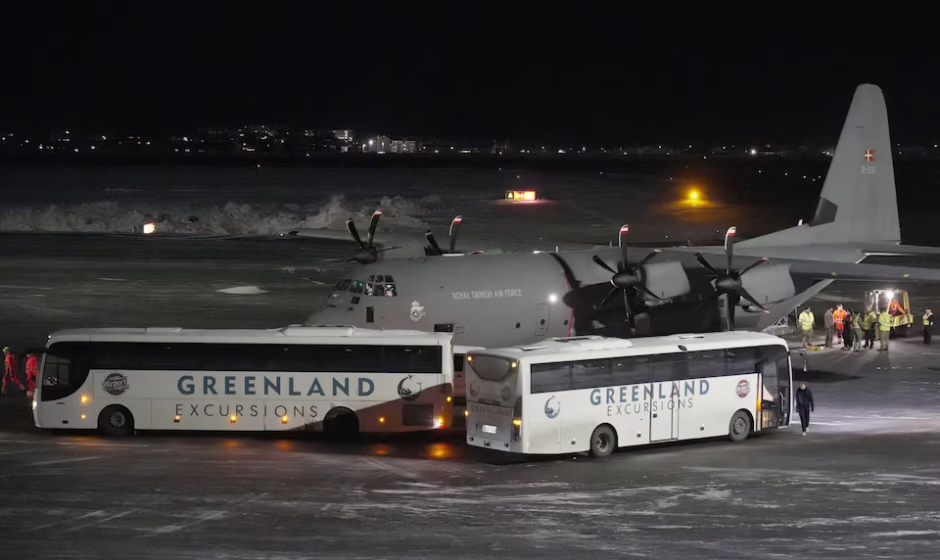

When military personnel arrive quietly in a remote place like Greenland, the move is rarely about the present moment alone. It’s about anticipation — the human instinct to secure what might matter tomorrow before someone else does. The recent arrival of European military forces on the island reflects a deeper shift in how nations are thinking about geography, security, and influence in a rapidly changing world.
Greenland has long existed on the edge of global attention, vast and sparsely populated, yet strategically positioned. As climate change alters Arctic access and geopolitical competition intensifies, what once felt distant now feels central. Human behaviour responds strongly to such shifts. When a place moves from irrelevant to essential, interest accelerates quickly.
The timing of this military presence matters. Statements from US leadership emphasizing the importance of Greenland have reframed the island not as a peripheral territory, but as a strategic asset. When powerful voices publicly express desire or necessity, others instinctively respond. In global politics, attention itself creates pressure.
From a behavioural perspective, this is about control and reassurance. Nations deploy people and resources not only to prepare for conflict, but to calm uncertainty — for themselves and their allies. A physical presence sends a message that interests are being watched, boundaries acknowledged, and influence asserted without confrontation.
For Greenland itself, the situation carries emotional complexity. Increased military attention brings visibility and perceived protection, but also raises questions about autonomy and identity. When larger powers focus on smaller regions, the local population often feels caught between relevance and vulnerability. Being important doesn’t always feel empowering.
On a broader level, this moment reflects how fear reshapes priorities. Fear of exclusion, fear of losing strategic ground, fear of being unprepared — these are powerful motivators. Even without immediate threat, the possibility of future tension is enough to trigger action. Human systems, like individuals, tend to act early when stakes feel irreversible.
There’s also an unspoken competition at work. Military arrivals are rarely isolated decisions; they are reactions to perceived moves by others. Each step feeds into a cycle of presence and response, where doing nothing feels riskier than doing something small.
Yet this isn’t necessarily a march toward conflict. Often, these actions are about deterrence and signaling rather than escalation. The goal is to shape expectations — to make clear who is paying attention and who has a stake.
Ultimately, Greenland’s moment in the spotlight reveals a familiar human pattern: when the future feels uncertain, people move closer to what they fear losing. Geography becomes psychology. Presence becomes reassurance.
As global focus drifts northward, Greenland stands as a reminder that even the quietest places can become central when power, perception, and preparation intersect.