

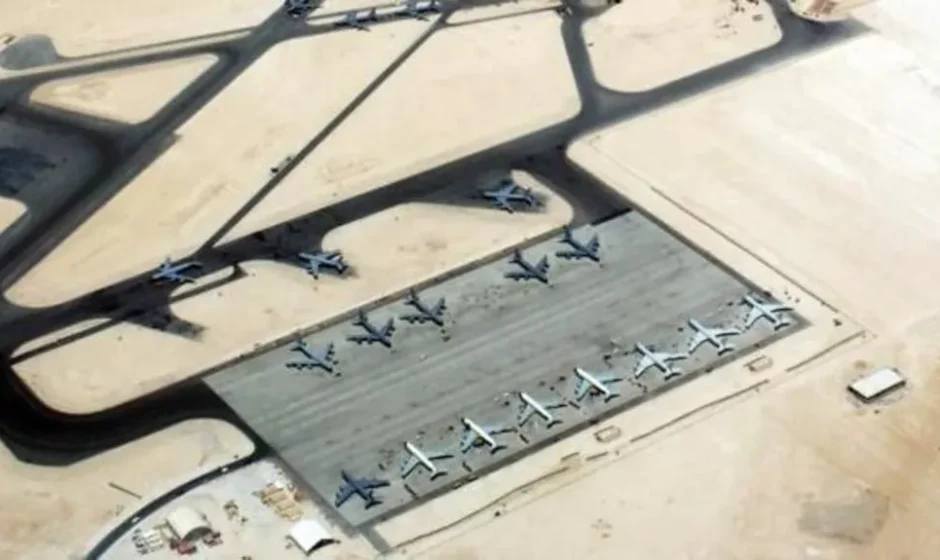

When a military quietly adjusts its footprint, the move often says more than any public statement. The decision by the United States to pull some personnel from an air base in Qatar is not framed as an emergency, yet it carries a familiar undertone of caution, the kind that appears when risk calculations start to change.
From a human-behaviour perspective, this is a classic example of pre-emptive adjustment. Institutions, like individuals, rarely wait for danger to fully materialize before acting. Instead, they respond to signals shifts in intelligence, rising regional tension, or the sense that uncertainty is increasing faster than comfort allows.
Qatar’s air base has long been a strategic hub, central to US operations across the Middle East. Any change there naturally draws attention, not because it signals retreat, but because it suggests reassessment. Reassessment is what humans do when familiar ground no longer feels entirely predictable.
Such moves are often designed to reduce exposure rather than provoke reaction. By pulling back personnel selectively, decision-makers aim to balance readiness with safety. It’s a behavioural pattern rooted in loss avoidance: reducing the chance of harm before circumstances force a more dramatic response.
For those stationed on the ground, these decisions ripple emotionally. Personnel may interpret them as precautionary, but also as a sign that conditions are shifting. Even small changes in deployment can heighten awareness, altering how people perceive risk and stability.
On a broader level, allies and observers read between the lines. Governments rarely announce concern outright; instead, they communicate through action. Adjusting troop presence becomes a form of messaging one that says vigilance is increasing, even if escalation is not the goal.
Public reactions tend to follow a predictable arc. Initial curiosity gives way to speculation: Is this temporary? Is something coming? The lack of detailed explanations often fuels anxiety, because humans naturally fill information gaps with assumptions.
Yet it’s important to note that such moves don’t necessarily point to imminent conflict. More often, they reflect strategic flexibility. Modern military planning prioritizes adaptability the ability to shift resources without triggering panic or overreaction.
From a behavioural lens, this moment reflects restraint rather than alarm. It shows an institution trying to stay ahead of potential risk while maintaining stability. The action itself is quiet, but the psychology behind it is clear: uncertainty has crossed a threshold where doing nothing feels riskier than doing something small.
In the end, the significance of this move lies not in the number of personnel involved, but in the mindset it reveals. In regions shaped by fragile balances, even subtle adjustments are signals reminders that preparedness today is often built on anticipation rather than reaction.
As tensions ebb and flow, such decisions highlight how power, caution, and human judgment intersect often away from headlines, but never without meaning.