

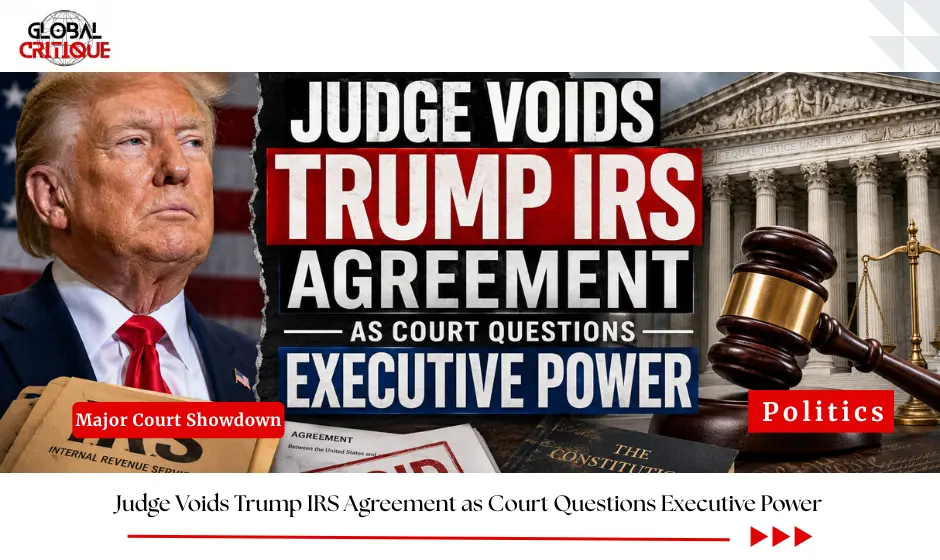

Judge Voids Trump IRS Agreement as Court Questions Executive Power
A federal judge has killed an agreement Donald Trump and the IRS had made following the IRS’s refusal to make the parties into a fake court settlement: that its terms couldn’t be trusted in a lawsuit and its defenses were therefore not covered by protections normally available to those in a real case, as Trump is now trying to leverage protections against those with a legal dispute over the IRS’s work and is looking to use protections.
The ruling has renewed concerns about presidential power conflicts of interest and the independence of the American justice system.
United States District Judge Kathleen Williams issued the decision on 13 July 2026. Her ruling focused on Trump’s 10 billion dollar lawsuit against the IRS and Treasury Department over the disclosure of his confidential tax information. The judge concluded that Trump’s personal lawyers and government attorneys were not acting as genuinely opposing parties which is a basic requirement in civil litigation.
What Happened in the Trump IRS Case
Trump filed the lawsuit in January 2026 alongside Donald Trump Jr Eric Trump and the Trump Organization. They accused the IRS and Treasury Department of failing to protect confidential tax records obtained by a former government contractor and disclosed to news organisations.
The case became highly unusual because Trump was both the claimant and the head of the executive branch controlling the agencies he was suing. His administration’s Justice Department was responsible for defending the government while senior officials remained politically accountable to him.
In May Trump agreed to withdraw the case under an arrangement negotiated between his private legal team and officials within his own administration. The agreement initially included a 1.776 billion dollar fund intended to compensate people who claimed they had been victims of government weaponisation.
The fund was later abandoned following bipartisan opposition in Congress. However the administration indicated that separate tax protection provisions would continue.
Trump’s political influence has also extended into British political discussion. His criticism of Greater Manchester Mayor Andy Burnham added an American dimension to the developing UK leadership debate.
Why the Judge Voids Trump IRS Agreement
Judge Williams found that the lawsuit was not a normal legal dispute between two parties with conflicting interests. According to her ruling the court process had been used to give legitimacy to an agreement that benefited Trump and his political allies.
She determined that lawyers involved in the case had attempted to separate Trump’s role as a private claimant from his authority as president. The judge rejected that distinction because Trump exercised control over the agencies and senior officials on the opposite side of the lawsuit.
The ruling stated that the action had not been brought to resolve a genuine factual or legal disagreement. Instead Williams found that it sought to support an arrangement granting protection to people and organisations connected to the president.
This finding is the main reason reports have described the outcome as a decision in which the judge voids the IRS agreement. Technically the order prevents the parties from presenting the arrangement as a legitimate court settlement or using its terms in future official proceedings.
That restriction effectively removes much of the agreement’s intended legal authority.
What Happens to Trump’s Tax Protections
The ruling creates serious uncertainty around provisions designed to protect Trump and his businesses from existing IRS audits and tax claims.
Williams ordered Trump his sons the Trump Organization the IRS and other government parties not to refer to the agreement or cite its terms in future legal or regulatory matters.
This step could weaken the provision preventing the IRS from pursuing earlier tax examinations involving Trump or his companies.
Some legal observers have noted a narrower distinction. The judge did not explicitly cancel every private promise contained in the agreement. However she ruled that the government could not claim those promises resulted from a valid adversarial court process.
In practical terms the judge voids agreement protections by stripping them of the judicial legitimacy that made them valuable. Any future attempt to rely on the audit immunity provisions may now face immediate legal challenges.
The ruling does not resolve the original allegations about the unauthorised disclosure of Trump’s tax information. Trump’s lawyers continue to argue that the IRS failed to protect confidential records and that those responsible should be held accountable.
Lawyers Face Possible Disciplinary Action
The decision also places several lawyers under professional scrutiny.
Williams referred Trump attorney Alejandro Brito to the Florida Bar for possible disciplinary action. She also said Daniel Epstein would not receive permission to file cases in the Southern District of Florida for up to one year.
Copies of the ruling were ordered to be sent to legal disciplinary authorities in New York and Washington DC. Those jurisdictions are examining complaints involving senior Justice Department officials including Acting Attorney General Todd Blanche and Associate Attorney General Stanley Woodward.
Williams raised concerns about the officials’ previous professional relationships. Blanche formerly served as Trump’s personal lawyer while Woodward had represented people connected to other Trump related legal cases.
The judge questioned why officials with these past relationships did not recuse themselves or provide a stronger defence of the government’s interests. Her ruling suggested that their conduct created the appearance that only one side’s interests were being represented.
Why the Ruling Matters Beyond the United States
For British readers the ruling matters because decisions involving American presidential power often affect wider debates about democratic accountability and the rule of law.
The United States remains one of the United Kingdom’s most important security diplomatic and trading partners. Questions about the independence of American institutions can therefore shape political confidence in Washington and affect relations with Downing Street.
The IRS ruling raises the question of whether courts can remain independent when a sitting president becomes personally involved in litigation against agencies under his authority.
It also highlights the constitutional risks created when political leadership private financial interests and public institutions become connected in a single legal dispute.
British political audiences may recognise similar concerns involving ministerial responsibility public appointments and government transparency. Although the constitutional systems differ the central question remains the same. Can public institutions act independently when powerful leaders have a personal interest in the outcome?
Political Pressure on the Trump Administration
The decision arrived shortly before Todd Blanche was due to appear before the Senate Judiciary Committee as part of his nomination process to become permanent attorney general.
The abandoned weaponisation fund and disputed audit protections were already expected to feature in the hearing. The judge’s criticism is likely to increase pressure on senators to ask whether Justice Department officials protected the public interest or allowed personal and political interests to shape government decisions.
Opposition to the agreement was not limited to Democrats. Republican lawmakers also raised concerns about the proposed fund and the possibility that taxpayer money could benefit Trump allies.
That bipartisan criticism is important. It suggests the dispute is not only another party political conflict. It also concerns broader constitutional limits on how presidents can use federal agencies public money and litigation involving their own interests.
The controversy may also influence public trust in the Justice Department. The department is expected to represent the interests of the United States rather than the personal interests of any president.
What Could Happen Next
Trump’s legal team may challenge parts of the ruling or dispute the judge’s continuing authority after the lawsuit was voluntarily dismissed. His lawyers previously argued that Williams no longer had jurisdiction once Trump withdrew the case.
Further proceedings could also examine whether government agencies remain bound by any parts of the private agreement that the court did not directly cancel.
The most immediate consequences may involve professional ethics investigations. State bar authorities will decide whether the lawyers and government officials named in the ruling violated their duties.
Congress may also consider stronger legal safeguards designed to prevent presidents and senior officials from personally benefiting through settlements with agencies they control.
The wider political outcome will depend on whether the ruling remains an isolated judicial rebuke or becomes part of a broader investigation into executive self dealing.
Trump’s wider relationship with the United Kingdom remains politically significant. His statements involving King Charles and Iran demonstrated how quickly domestic American politics can overlap with British constitutional and foreign policy debates.
Judge Voids Agreement as Courts Defend Their Independence
The judge voids Trump IRS agreement by preventing the arrangement from gaining legitimacy through the federal court system. Although legal debate may continue over the status of individual provisions the ruling makes clear that parties cannot create the appearance of a genuine lawsuit when their interests are effectively aligned.
Williams presented the decision as a defence of the constitutional purpose of the courts. Her ruling sends a wider warning that litigation cannot be used merely to approve political arrangements grant personal immunity or direct public resources without a legitimate legal dispute.
The case will remain politically important because it connects several major issues. These include Trump’s tax affairs presidential conflicts of interest the conduct of Justice Department officials and the ability of judges to challenge executive power.
For the United Kingdom and other American allies the controversy provides another test of whether democratic institutions can enforce limits on political leaders even when those leaders control much of the government surrounding them.
Related Articles
US UK Trade Deal Tension Rises as Trump Pressures Starmer
Starmer Mandelson Vetting Inquiry Vote Deepens UK Political Crisis