

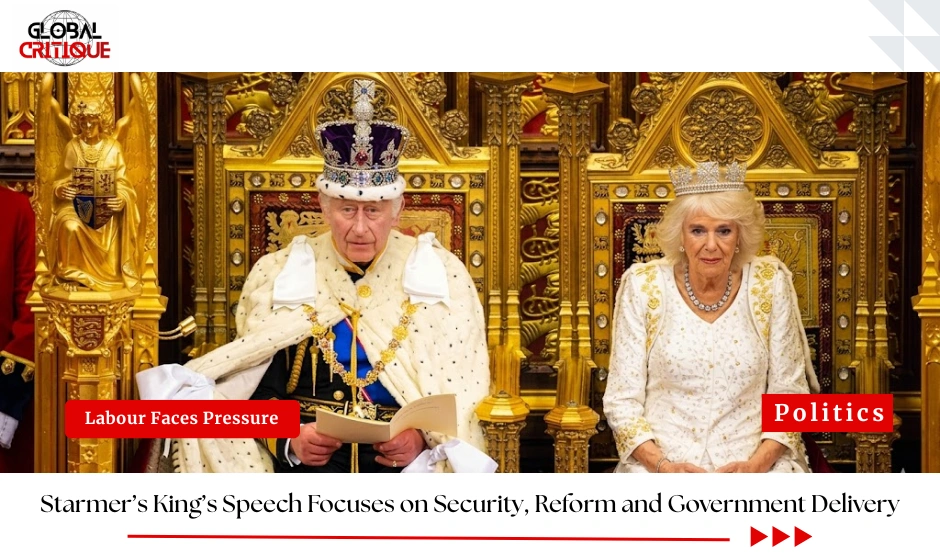

Labour Attempts to Shift From Survival to Long Term Renewal
Sir Keir Starmer’s second King’s Speech was designed to show that the Labour government is moving beyond political survival and toward a broader programme of national renewal. Delivered during a period of growing international instability and domestic political pressure, the speech aimed to reassure voters that the government still has direction, authority, and the ability to deliver meaningful change across Britain.
The proposals outlined in the King’s Speech form part of Labour’s broader legislative agenda for the upcoming parliamentary session. The government attempted to present a long-term strategy focused on economic resilience, public service reform, infrastructure investment, and national security.
The speech arrived at a difficult moment for Labour. Recent election setbacks, declining poll numbers, and criticism from within the party have increased pressure on Starmer’s leadership. At the same time, parties such as Reform UK, the Liberal Democrats, and the Green Party are competing for support across Labour’s voter base.
Against this backdrop, the King’s Speech became more than a list of policy announcements. It served as a political statement intended to restore confidence in the government’s direction and strengthen Labour’s public image ahead of future electoral challenges.
Security Becomes the Core Theme of Government Strategy
One of the strongest themes throughout the speech was security. The government linked almost every major policy area to the idea of protecting Britain during an uncertain global period.
Defence, energy, housing, cyber protection, economic stability, border control, and public institutions were all framed as part of a wider national security strategy.
The government argued that Britain faces growing challenges from geopolitical conflict, economic instability, cyber threats, and international competition. Ministers presented the need for a more active and interventionist state capable of responding quickly to rapidly changing global risks.
Starmer’s message was clear: long-term stability and resilience require stronger institutions and a government willing to play a larger role in shaping the country’s future.
This approach also reflects Labour’s attempt to answer criticism from opponents who argue the country has lost control over key issues such as immigration, economic growth, and public service performance.
Rather than focusing on populist rhetoric or disruptive political messaging, Labour is attempting to position itself as the party of practical reform, institutional stability, and national resilience.
Political Pressure Continues to Build Around Starmer
The speech comes during a period of growing political tension for the prime minister.
Recent polling from major UK research firms has shown increased pressure on Labour from Reform UK and other opposition parties. Labour’s support has weakened in several regions following disappointing local election performances and criticism surrounding government delivery.
Reports also suggest some Labour MPs and junior ministers remain concerned about the pace of reform and the government’s broader political direction.
Despite these pressures, Starmer insisted the government must continue focusing on long-term reforms rather than short-term political reactions.
The speech repeatedly emphasized:
- delivery
- competence
- stability
- institutional reform
Ministers hope that visible improvements in infrastructure, healthcare, housing, and economic performance can rebuild public trust before future national elections.
Political analysts believe the government understands that voter patience may be limited. While structural reforms often take years to deliver measurable results, many voters are more likely to judge the government based on everyday concerns such as:
- living costs
- wages
- healthcare access
- housing affordability
- public safety
Economic Reform and the Return of the Active State
A major message from the speech was Labour’s support for a more active role for the state in the economy.
Rather than leaving markets entirely to private forces, the government plans to use public investment, industrial policy, and targeted regulation to encourage growth, infrastructure development, and long-term economic resilience.
The speech highlighted plans to:
- reduce unnecessary regulation
- improve trade relationships
- support domestic industries
- accelerate infrastructure projects
- tackle late business payments
Labour’s strategy appears designed to balance public sector leadership with private sector cooperation.
The government wants to show that economic growth can be achieved through partnership rather than strict state control or unrestricted market policies.
Business groups are likely to judge this approach based on whether:
- projects are delivered efficiently
- regulations become easier to navigate
- investment conditions improve
- economic growth becomes more stable
Infrastructure and Energy Security Take Centre Stage
Infrastructure development featured heavily throughout the speech.
The government confirmed support for major transport projects including:
- airport expansion
- Northern Powerhouse Rail
- road upgrades
- the Lower Thames Crossing
These projects are intended to improve regional connectivity and stimulate long-term economic growth across Britain.
Energy policy was also closely connected to national security.
Ministers argued that increasing domestic energy production and reducing reliance on unstable international markets is essential for protecting households and businesses from future economic shocks.
Clean energy investment was presented not only as an environmental goal but also as a strategy for strengthening Britain’s economic independence and industrial resilience.
However, major infrastructure and energy projects continue facing:
- planning delays
- financing challenges
- supply chain pressures
- political opposition in some regions
The success of Labour’s long-term growth strategy may depend heavily on how quickly these projects move from announcement to delivery.
Technology and Digital Reform Gain Greater Importance
The speech also confirmed plans for digital identity systems and broader technological reforms across government services.
Ministers argued that digital modernization could improve efficiency, simplify access to public services, and reduce administrative costs across government departments.
Artificial intelligence and cyber security were highlighted as areas of growing strategic importance.
The government believes AI could improve productivity across:
- healthcare
- infrastructure management
- public administration
- business operations
At the same time, cyber security has become increasingly important as governments and businesses face growing digital threats globally.
However, concerns remain regarding:
- privacy
- regulation
- transparency
- public trust
Critics argue that poorly managed digital reforms could increase fears surrounding surveillance or exclusion from public services.
The long-term success of these reforms will likely depend on whether the government can balance innovation with accountability and public confidence.
NHS Reform Remains a Major Political Test
Healthcare reform continues to be one of Labour’s most important political challenges.
The speech promised reforms aimed at:
- reducing bureaucracy
- improving patient care
- supporting earlier medical intervention
- accelerating NHS modernization
Ministers also emphasized the importance of innovation and technology adoption within the NHS.
Long waiting lists, workforce shortages, and pressure on hospitals remain major concerns for voters across the country.
Healthcare experts argue that improving NHS performance will require more than administrative reform alone. Faster adoption of medical technology, stronger workforce planning, and better integration across healthcare services will also be necessary.
The government hopes healthcare improvements can demonstrate Labour’s ability to manage public services effectively.
However, expectations remain extremely high, and visible progress will likely be required to maintain public confidence.
Housing, Education and Public Trust Included in Reform Plans
Housing and education also formed key parts of the government’s broader reform strategy.
Ministers announced plans to:
- increase investment in social housing
- reform leasehold rules
- address unsafe cladding in residential buildings
The government argued that stable housing remains closely connected to economic security and long-term social stability.
In education, Labour promised reforms aimed at improving school standards and addressing pressures within the special educational needs system.
Families across Britain continue facing difficulties accessing educational support services, and ministers acknowledged the need for long-term structural improvements.
The speech also focused on rebuilding public trust in institutions after years of political instability and public frustration.
Measures such as the proposed Hillsborough Law and stronger accountability standards for public officials were presented as part of Labour’s effort to restore confidence in government and public life.
A Defining Moment for Labour’s Government
Overall, Starmer’s second King’s Speech attempted to present Labour as a government focused on delivery, stability, and long-term national resilience.
Security served as the central theme connecting defence, economic reform, infrastructure, healthcare, housing, education, and technology policy into one broader political narrative.
The government’s challenge now is turning these ambitions into visible results.
Political pressure on Starmer remains intense, and voters are increasingly demanding practical improvements in daily life rather than long-term promises alone.
Whether Labour can successfully move from political management to lasting national renewal may ultimately depend on its ability to deliver measurable progress across the economy, public services, infrastructure, and national security in the months ahead.
Conclusion
In conclusion, Keir Starmer’s second King’s Speech aimed to present Labour as a government focused on stability, reform, and national renewal. By linking security with economic growth, healthcare, infrastructure, and public services, Labour attempted to show a clear long-term vision for Britain. However, the government’s success will depend on whether it can deliver real improvements in people’s daily lives and rebuild public trust in the months ahead.
Stay updated with UK politics, economy, and global affairs only on Global Critique.