

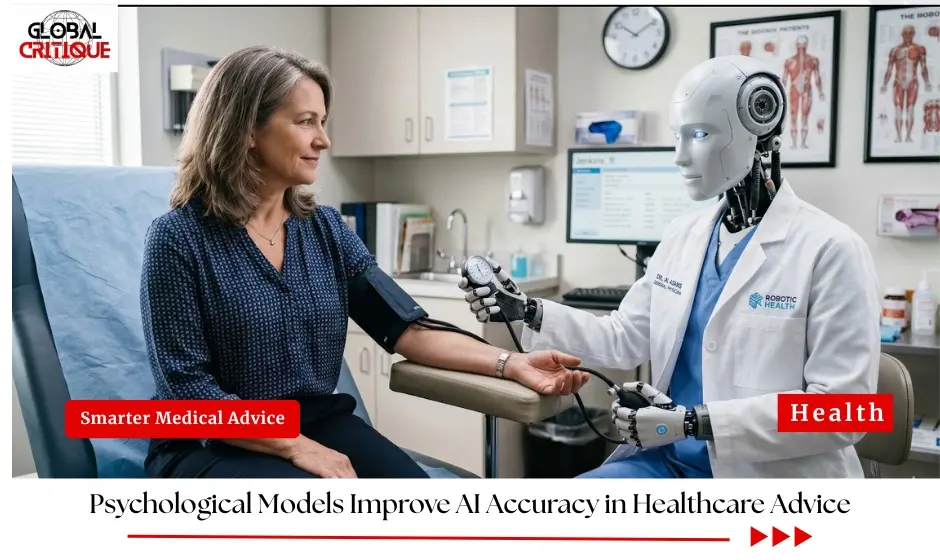

Researchers Explore Human Style Thinking in AI Models
Researchers at the Technische Universität Berlin have found that large language models can provide more accurate healthcare advice when they are guided to think more like humans. The study, published in JMIR Biomedical Engineering by JMIR Publications, suggests that combining psychology based reasoning with AI prompt design can significantly improve medical decision support.
Shift From Technical Prompts to Psychological Approaches
The research highlights a shift away from traditional computer focused instructions toward methods inspired by human psychology. As more people use AI tools such as ChatGPT for health related questions, a common issue has been that systems often recommend professional or emergency care even for minor symptoms. This cautious approach can sometimes lead to unnecessary concern and healthcare costs.
Naturalistic Decision Making Improves AI Reasoning
The study was led by Marvin Kopka and Markus A. Feufel, who tested multiple language models including GPT 4o and GPT 5. They used techniques based on Naturalistic Decision Making, a psychological approach that studies how experts make decisions in real world uncertain situations.
Researchers applied two key methods.. Recognition primed decision making encouraged the AI to compare symptoms with known cases and mentally simulate outcomes. Data frame theory required the model to build an understanding of the situation and continuously reassess it as new information arrived..
Improved Accuracy and Better Self Care Recommendations
Results showed a clear improvement in performance across all tested models. One of the most notable changes was in self care advice accuracy, which increased from about 13 percent using standard prompts to nearly 30 percent with psychologically informed reasoning.
Even simpler AI models that previously struggled began giving more balanced and accurate recommendations when guided by human style reasoning patterns. Importantly, the system maintained its ability to correctly identify serious medical emergencies.
Study Highlights Potential for Real World Healthcare Use
Researchers noted that real world medical situations are often incomplete and uncertain. It making rigid computational logic less effective. By using human inspired reasoning frameworks, AI systems were better able to simulate outcomes and refine their responses.
The study suggests that this approach could improve AI based decision support in healthcare settings. It especially where information is unclear or incomplete. However, researchers also emphasized that further testing is needed before these methods can be widely used in everyday medical applications outside controlled environments.
Explore more AI and healthcare innovations shaping the future of medical care.