

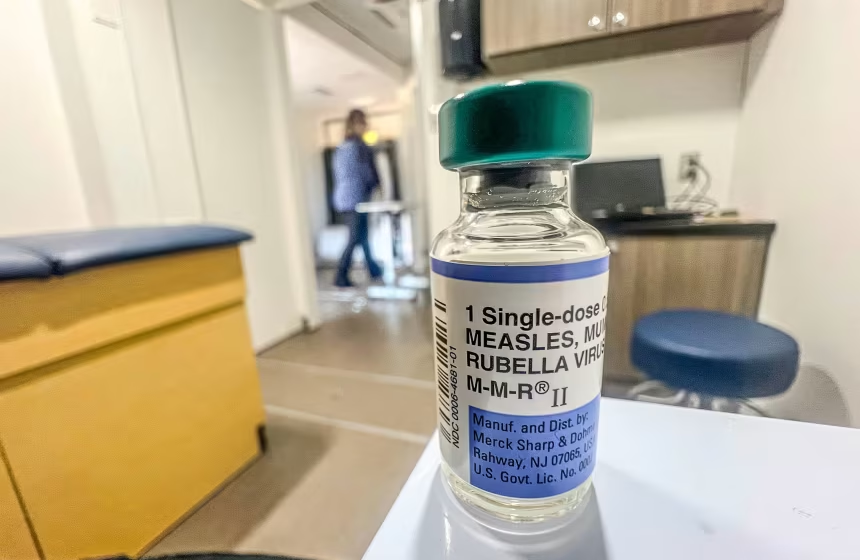

When public health officials speak calmly about infectious disease risks, the words are often meant to reassure. But reassurance itself can provoke unease, especially when it concerns illnesses many people believed were firmly in the past. Recent comments downplaying concerns around measles elimination have reopened a quiet but important question: how secure is public health progress when confidence outpaces caution?
From a human-behaviour perspective, diseases like measles carry symbolic weight. They are not just medical conditions; they are markers of collective success. Elimination represents trust in vaccines, institutions, and shared responsibility. When that trust is questioned, even indirectly, people instinctively feel unsettled.
Public health systems operate on probabilities, not absolutes. Officials assess risk based on data, trends, and containment capacity. But the public processes risk differently. People think in terms of safety versus danger, not statistical thresholds. When an authority suggests that elimination status isn’t a pressing concern, many hear something else entirely: complacency.
This gap between professional assessment and public perception is where anxiety grows. Humans are wired to respond strongly to threats involving children, community exposure, and loss of control. Measles, with its high contagion and visible symptoms, triggers all three. Even a small outbreak can feel disproportionately alarming.
Another layer is behavioural fatigue. Vaccination campaigns rely on long-term cooperation. Over time, success breeds forgetfulness. When diseases become rare, urgency fades. This creates vulnerability not because systems fail, but because participation weakens. Public health depends as much on behavior as on medicine.
Professionally, officials often emphasize that elimination does not mean eradication. It means transmission is contained, monitored, and manageable. But that nuance rarely travels intact. In public discourse, words flatten. Confidence can sound dismissive, even when it’s rooted in data.
There’s also a trust dynamic at play. In an era where institutions face skepticism, communication must work harder. Calm authority reassures some, but alarms others. People want transparency not just about what isn’t a concern, but about what could become one if vigilance slips.
The real risk may not be measles itself, but the erosion of shared responsibility. When individuals believe threats are minimal, protective behaviors decline. Vaccination rates dip. Gaps widen. The system remains strong until suddenly it isn’t.
This moment serves as a reminder that public health is fragile not because it lacks tools, but because it relies on collective participation. Confidence must be balanced with clarity. Reassurance must come with responsibility.
In the end, the question isn’t whether measles elimination is under immediate threat. The deeper question is whether societies can maintain the behaviors that made elimination possible in the first place even when the danger feels distant.
Progress, after all, doesn’t disappear overnight. It erodes quietly, when attention drifts and certainty replaces care.